

5 Tips for Successful AI credits
Plus: Updates from OpenAI, Datadog, Hubspot, Mongo, and Zoom.

Welcome back to Good Better Best.
Each week, we break down real pricing, packaging, and product moves from SaaS leaders and share the ideas worth stealing.
This week, we published an exclusive report with our friends at Nue.io. The report highlights how companies are blending PLG and SLG through acquisition and expansion strategies, and is jam-packed with examples.
Today, we’re sharing 5 learnings from our latest Office Hours session with Manny Medina, CEO of Paid. Paid is the monetization platform for AI agents, and Manny talks to 5-6 SaaS leaders a day, often helping them workshop their AI credit strategy.
Let’s get to it.
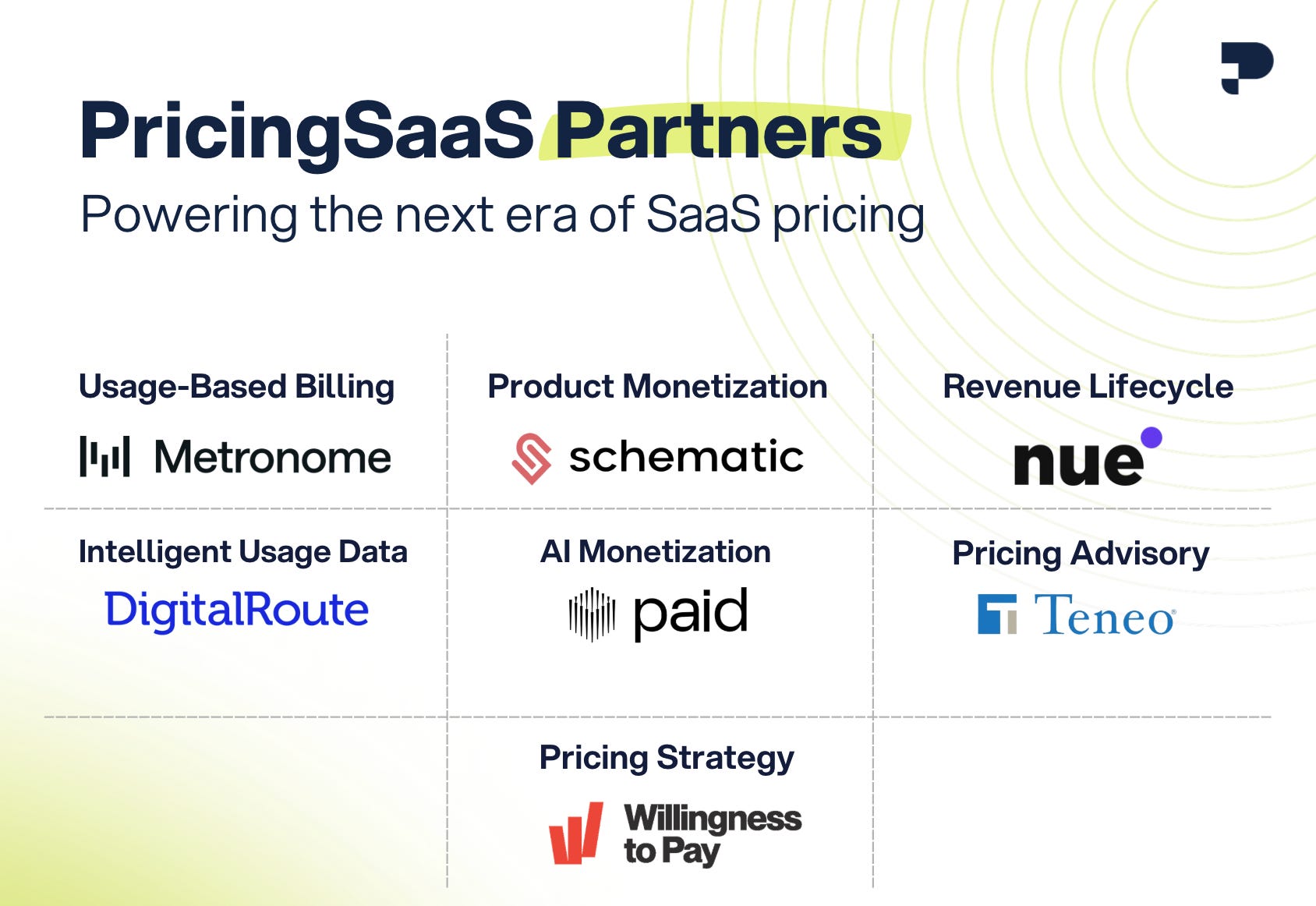
🔌 PricingSaaS Partners power the next era of SaaS pricing
This Week in Pricing, Packaging, and Product
Last week we observed 150+ changes. The highlights:
OpenAI tripled GPT-5 mini pricing and launched a nano tier [Link]
Datadog added Edge Device Monitoring [Link]
Hubspot launched 3 beta features for the Enterprise suite [Link]
MongoDB restructured Atlas tiers [Link]
Zoom launched an Enhanced Media add-on [Link]
Check out more updates on PricingSaaS →
PricingSaaS Pulse Intelligence
Here’s what was top of mind in Pulse this week:
🔥 Hot Companies
Notion — 32 searches
Asana — 18 searches
Figma — 13 searches
Linear — 12 searches
Adobe — 10 searches
🚨 Hot Topics
Annual contract discount benchmarks — how much to offer for annual commitments, and what the median looks like by ACV
Agentic AI pricing models — how to price per outcome, per document, or per usage metric for AI-powered features
Competitive pricing set mapping — side-by-side comparisons across direct competitors to find positioning gaps
Credit-based pricing frameworks — how to structure token and credit monetization for AI features
Per-seat vs usage-based tradeoffs — when to move away from seat pricing and what to replace it with
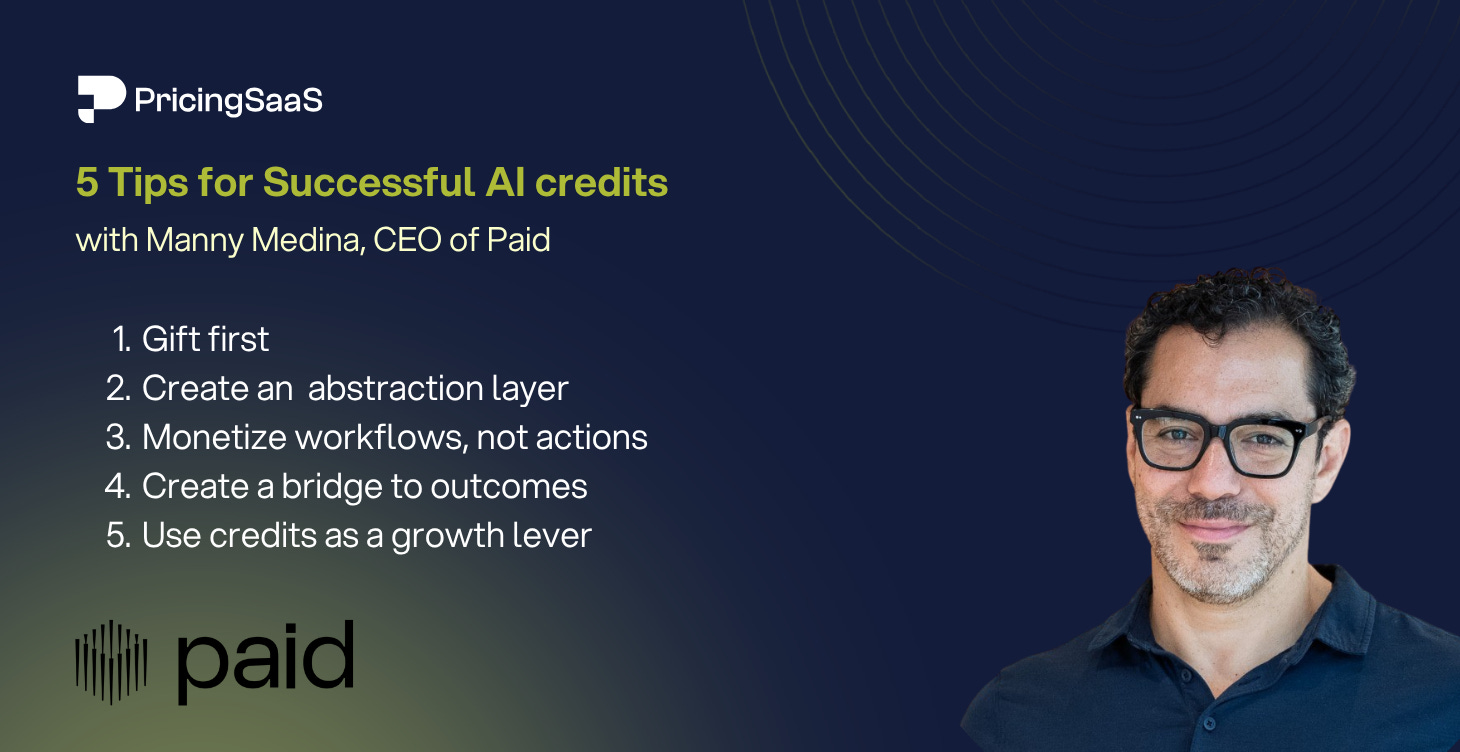
Last week, we hosted an Office Hours session with Manny Medina, CEO of Paid. This one was jam-packed with thoughful discussions around one of the hottest topics in SaaS — AI credit models.
Below, I’m breaking down the top 5 takeaways that you can steal for your own AI credit strategy.
1️⃣ Use a “gift first” approach to transition existing customers to credits.
This was Manny’s top advice for anyone introducing credit-based models alongside an existing seat-based model. Instead of asking customers to pay more, position the new capability as a feature that’s included in their seat — but powered by credits.
You’re essentially saying: “We normally charge for this on a credit basis, but because you’re a loyal customer, we’re going to bundle some credits for the next few months so you can see the value.”
Once those months are up and customers have seen value, the commercial conversation is natural. Manny framed this through Cialdini’s reciprocity principle — when you give someone a gift, they feel a natural pull to give something back when appropriate.
2️⃣ Create an abstraction layer between your internal rate card and customer-facing pricing.
Manny was emphatic that your internal rate card — where you track costs per API call, token consumption, model type — should never be what the customer sees.
The customer needs to see value in their language: tasks completed, reports generated, time saved, risk avoided.
Lisa from Pendo raised a great follow-up, asking how to manage constant pricing changes when the underlying models keep evolving. Manny’s advice: keep the rate card changes internal. When costs change, you frame it to the customer positively — “we have a new, more powerful capability, here are some free credits to try it” — rather than exposing the complexity underneath.
3️⃣ Monetize around workflows, not individual actions.
Riley from ClickUp asked how to deal with downward pressure on credit prices as foundation models get cheaper.
Manny’s answer was to move up the value chain. Instead of charging per LLM call or token (where you’re basically reselling commodity infrastructure with a thin margin), build monetization around complete workflows — composite sets of activities that result in a tangible task or output.
If it’s tied to something a human would have had to do, the value metric becomes “human equivalent work” and your margin stays healthy regardless of what happens to token prices.
He shared a real example from a Paid customer doing accounting reconciliation: they narrowed it down to four core workflows their customers execute, each mapping to work an accountant would otherwise do manually.
4️⃣ Credits are a bridge to outcome-based pricing. Start planning for outcomes now.
Manny laid out a multi-chapter roadmap for how AI monetization is evolving. Right now, we’re in the earliest chapter: transitioning from seats to credits.
Next comes standardization — credit models will become comparable across vendors, and “credit efficiency” (how much value you get per dollar of credits) will become a real metric.
After that, credits start getting tied to outcomes, and eventually you’re buying outcomes directly. He was candid that we’re probably two years away from that, but said for every five SaaS companies he talks to about this, four say they’re not ready. His advice: you don’t need to have it perfect. Just start the conversation about outcomes now.
5️⃣ The real unlock with credits isn’t monetization — it’s growth.
The smartest companies aren’t just using credits as a new way to bill customers — they’re using them as a growth engine.
Manny mentioned Cursor using credits to incentivize off-peak usage, Lovable pioneering free daily credits that hook new users, and how granting credits to your most engaged power users (not just low-usage customers) can drive adoption of new features and create viral expansion within organizations.
Manny views credits as a flexible tool to power creative growth strategies that wouldn’t be possible with license models. The big mindset shift: stop thinking about credits as a billing mechanism and start thinking about them as a lever for adoption, retention, and expansion.
Thanks again to Manny, and everyone who attended this session! Join the PricingSaaS Community on Skool to stay informed on the next one.
Thanks for reading! When you’re ready, here’s how we can help:
Community: Answers from real pricing experts. Apply for membership →
Data: Access to news, research, and analysis. Sign up for free →
Advisory: Free pricing advice. Book a 30-minute call →
Another emerging best practice is to gift credits in return for the user taking actions you want to encourage. Lovable gives one credits for coming to Lovable everyday. Another example is the gifting of credits in return for introductions (encouraging virality).