

How to Optimize your Pricing Page for Agents
Plus: Updates from Cloudflare, Customer, Linear, Anthropic, and Twilio.

Welcome back to Good Better Best.
Each week, we break down real pricing, packaging, and product moves from SaaS leaders and share the ideas worth stealing.
Today, we’re breaking down a move by Buffer, who added a dedicated markdown file to make it easy for agents to understand its pricing. I covered what, why, and how they did it below.
Before we get there — we’re cohosting some awesome events next week that you should definitely check out:
PricingSaaS Office Hours: On Monday, I’m hosting a session with Ulrik Lehrskov-Schmidt, breaking down how to monetize professional services in the age of AI. Register here.
Pricing Power Lunch (Boston): We have a couple seats left. If you are a SaaS operator in Boston working on AI pricing, we’d love to have you at the table. Reply directly if you’d like to join.
The Hidden Cost of Hybrid Pricing: Next week, I’m joining a panel with Zona Zhang from Clay, and Jyotsana Saha from Nue.io to break down where AI-driven monetization breaks and how to fix it. Register here.
On to today’s post.
🔌 PricingSaaS Partners power the next era of SaaS pricing
This Week in Pricing, Packaging, and Product
This week we observed 100+ changes. The highlights:
▶ Cloudflare added client-side security tiers with malicious code detection [Link]
Timing is hard to ignore given the Mythos/Glasswing moment. When AI can find and exploit your vulnerabilities at scale, client-side security stops being a nice-to-have.
▶ Customer launched AI Agent tiers with LLM Actions and Daily Routines [Link]
Customer created a clear packaging ladder: agent skills and action credits that escalate with each plan. Premium adds Daily Routines (scheduled autonomous workflows). Great example of the different levers youn can pull to monetize agentic functionality.
▶ Linear introduced sub-team depth limits to Business plans [Link]
Previously, sub-teams didn’t have visible limits. Now Business supports 1 level, and Enterprise supports 5. This feels like an intuitive upgrade trigger for organizations that need more structure.
▶ Anthropic added a price change clause to its pricing footnote [Link]
Previously the footnote only covered usage limits and tax exclusions. A small legal change, but one that gives them runway for the pricing adjustments that Mythos-class capabilities will inevitably require.
▶ Twilio added a $35 per monthly user tier to Flex pricing lineup [Link]
This slots in between the existing $1/hour usage model and $150/named seat. A pricing model hedge that gives mid-market buyers a middle ground between pure consumption and full commitment.
Check out more updates on PricingSaaS →
PricingSaaS Pulse Intelligence
Here’s what was top of mind in Pulse this week:
🔥 Hot Companies
Notion — 28 searches
Zendesk — 13 searches
Slack — 12 searches
Atlassian Jira — 12 searches
Clay — 10 searches
🚨 Hot Topics
Outcome-based pricing for AI — how to price around results rather than inputs
Embedded payments SaaS monetization — turning payments into a revenue stream
Term length discount trade-offs — when annual discounts help vs. hurt
Per-seat vs flat-rate for SMB — which model wins for small team products
Usage-based migration best practices — how to move from flat-rate to consumption pricing
How to Optimize your Pricing Page for Agents
Buffer did something this week that people are just starting to talk about. They added a link for machine-readable pricing [link]:
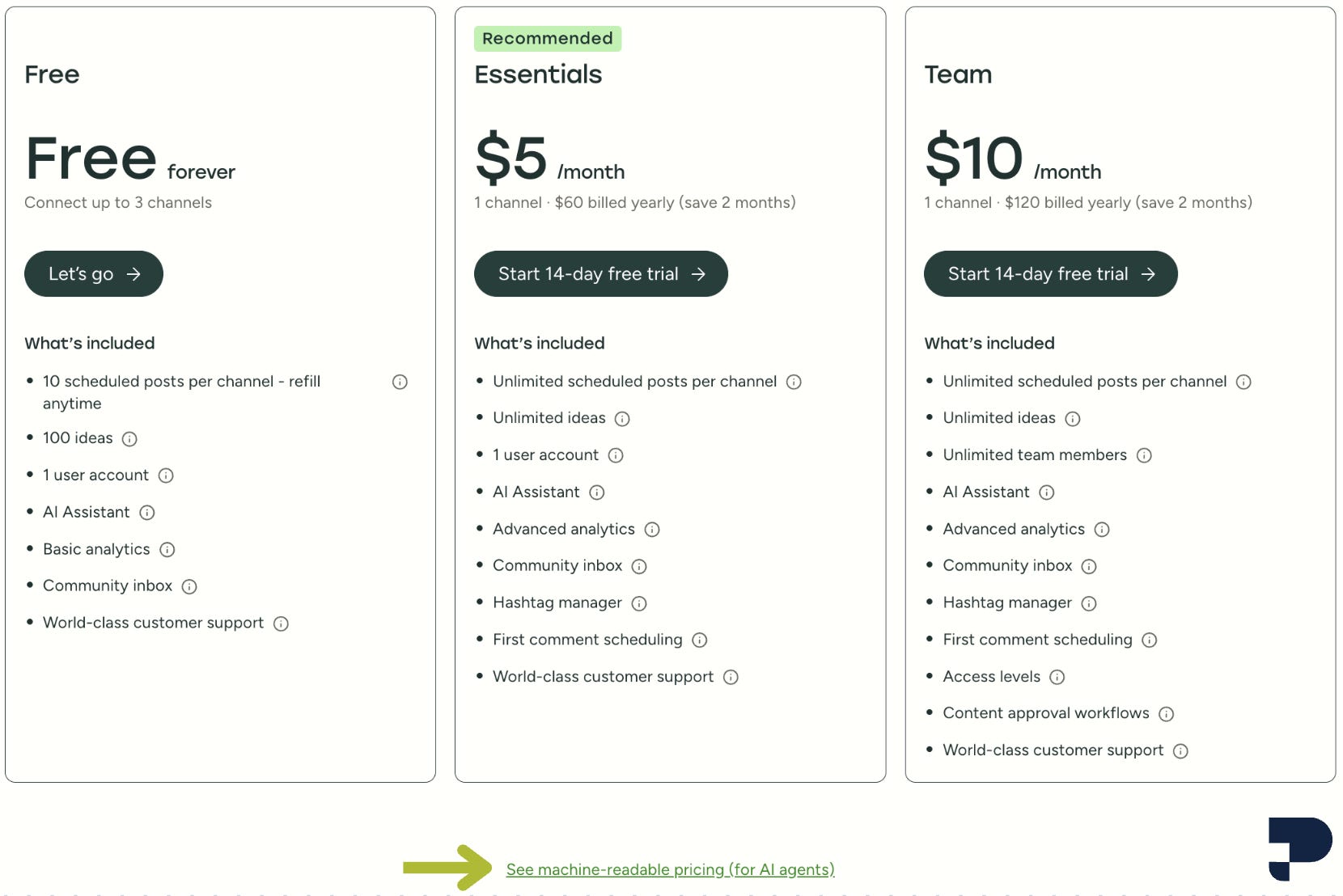
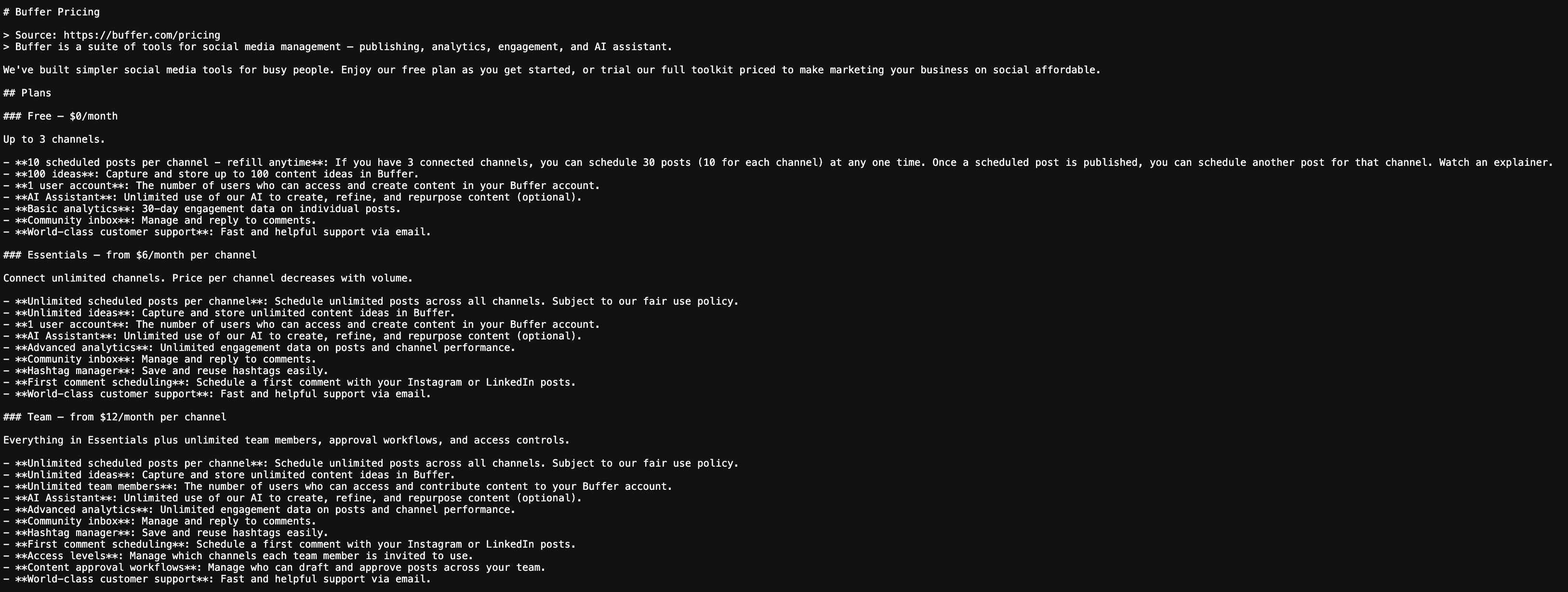
The link sits under their main pricing grid. Click it, and you land on /pricing.md — a structured markdown file that serves Buffer’s full plan and pricing data in a format designed for AI agents to parse. Here’s what it looks like:
You’ve probably noticed growing interest in how AI agents interact with websites and products. Kyle Poyar wrote a great post a couple weeks back, and it was a focal point of his recent interview with Metronome CEO, Scott Woody.
Put simply, we’re already in a world where procurement tools, comparison engines, and AI assistants evaluate software on behalf of humans.
When someone asks Claude or ChatGPT “what’s the best social media scheduling tool under $20/month?” the model needs to get that pricing data from somewhere. Today, it requires scraping a pricing page, interpreting a screenshot, or relying on training data that might be months out of date.
Buffer’s move shortcuts all that, and gives agents an easy button to understand the granular details of their pricing and packaging quickly.
Buffer’s move doesn’t exist in a vacuum
It’s part of a broader shift that started with llms.txt — an emerging standard where companies publish a markdown file at their site root that tells AI crawlers what the site is about and where canonical content lives. Over 800 websites have adopted it, including Cloudflare, Vercel, and Coinbase.
Buffer took it a step further. While llms.txt is a general-purpose discovery layer, they published structured pricing data explicitly for agent consumption.
The implementation is a simple .md file. Which makes sense, since Markdown is the native language of LLMs, and it’s easy to maintain alongside a normal pricing page. They didn’t build some elaborate pricing API, they just translated their pricing in a format that machines read well, linked it in an easy to find place on the main page, and shipped it. The whole thing probably took an afternoon.
The barrier to doing this is near zero. Any SaaS company with a pricing page could publish a /pricing.md tomorrow to help AI agents get their pricing exactly right. No hallucinations or misinterpretations from a cached screenshot (we happen to know this struggle well at PricingSaaS 😅).
Here’s what I think gets interesting
Once pricing data is machine-readable, it becomes comparable at scale. An AI agent can pull /pricing.md from ten social media tools, normalize the data, and produce a comparison table in seconds — with accuracy that no human analyst could match for speed. That’s great for buyers. It’s terrifying if your pricing is confusing, your value prop is unclear, or your page is designed to obscure the real cost.
In other words: machine-readable pricing is a forcing function for pricing transparency and clarity.
If your pricing page requires a human to squint, click through three tabs, and do mental math to understand what they’re actually paying, an AI agent is going to struggle with it too. And unlike a human, the agent may just move on to the next option.
Buffer’s move is small in execution and big in implication. We’re entering a world where your pricing page has two audiences: humans who browse and agents who parse. The companies that recognize this early, and make their pricing legible to both, are going to win more of the deals they never even knew were happening.
A /pricing.md file is the lowest-effort, highest-signal thing you can ship this quarter. Buffer just showed everyone how.
Thanks for reading! If you’re working on monetization and want to learn more about how we help, book time here.
Until next time,
Rob