

Outcome-Based Positioning
Plus: Updates from Stripe, Vanta, Auth0, Vercel, and Supermetrics.

Welcome back to Good Better Best.
Each week, we break down real pricing, packaging, and product moves from SaaS leaders and extract the ideas worth stealing.
This week, we’re comparing two positioning updates that shift the value conversation from inputs to outcomes. One is an iterative approach from a legacy SaaS staple (Constant Contact), the other a radical approach from an up-and-coming AI player (Lindy). First, the usual dose of pricing, packaging, and product news. Let’s get to it.
PS. Next week we’re hosting an Office Hours session on Intelligent Usage Metrics from both the strategic and technical lens. Learn more and register here.
🔌 PricingSaaS Partners power the next era of SaaS pricing
This Week in Pricing, Packaging, and Product
Stripe formally introduced its Merchant of Record product
Auth0 made Machine-to-Machine (M2M) auth available in its Essentials plan
Vercel launched Flags functionality in beta.
Fireworks revamped its AI model lineup.
Employment Hero bundled an AI Recruitment Agent in all plans.
Supermetrics added Data Residency controls to Enterprise.
SignalHire revamped prices across all plans.
Jam added MCP access to all plans.
Colossyan split video minutes across NEO 1 and NEO 2 models.
Vanta removed the “add on” label for several Enterprise features.
Check out more updates on PricingSaaS →
Outcome Based Positioning: Choose your Speed
Historically, SaaS companies have used a familiar group of value ladders to differentiate plans and drive upgrades:
Capabilities: Pay more as tools become more powerful and flexible.
Volume: Pay more for higher usage and throughput.
Risk/Trust: Pay more as risk decreases.
Support/Service: Pay more for hands-on help.
Automation: Pay more for less manual effort.
These still work, but agentic AI has introduced a new value ladder that is far more compelling:
Outcomes: Pay more as work is completed for you.
While outcome-based pricing is still in its infancy, companies are starting to shift their positioning from “enabling work” to doing work for you. As Scott Galloway has said:
“The story always outpaces the fundamentals.”
This week, we saw two positioning updates at different ends of the “outcome-based” spectrum, and wanted to highlight each to show both an iterative and radical approach to product positioning in the age of AI.
Example 1: Constant Contact
Shifted to action-oriented plan copy (Link →)
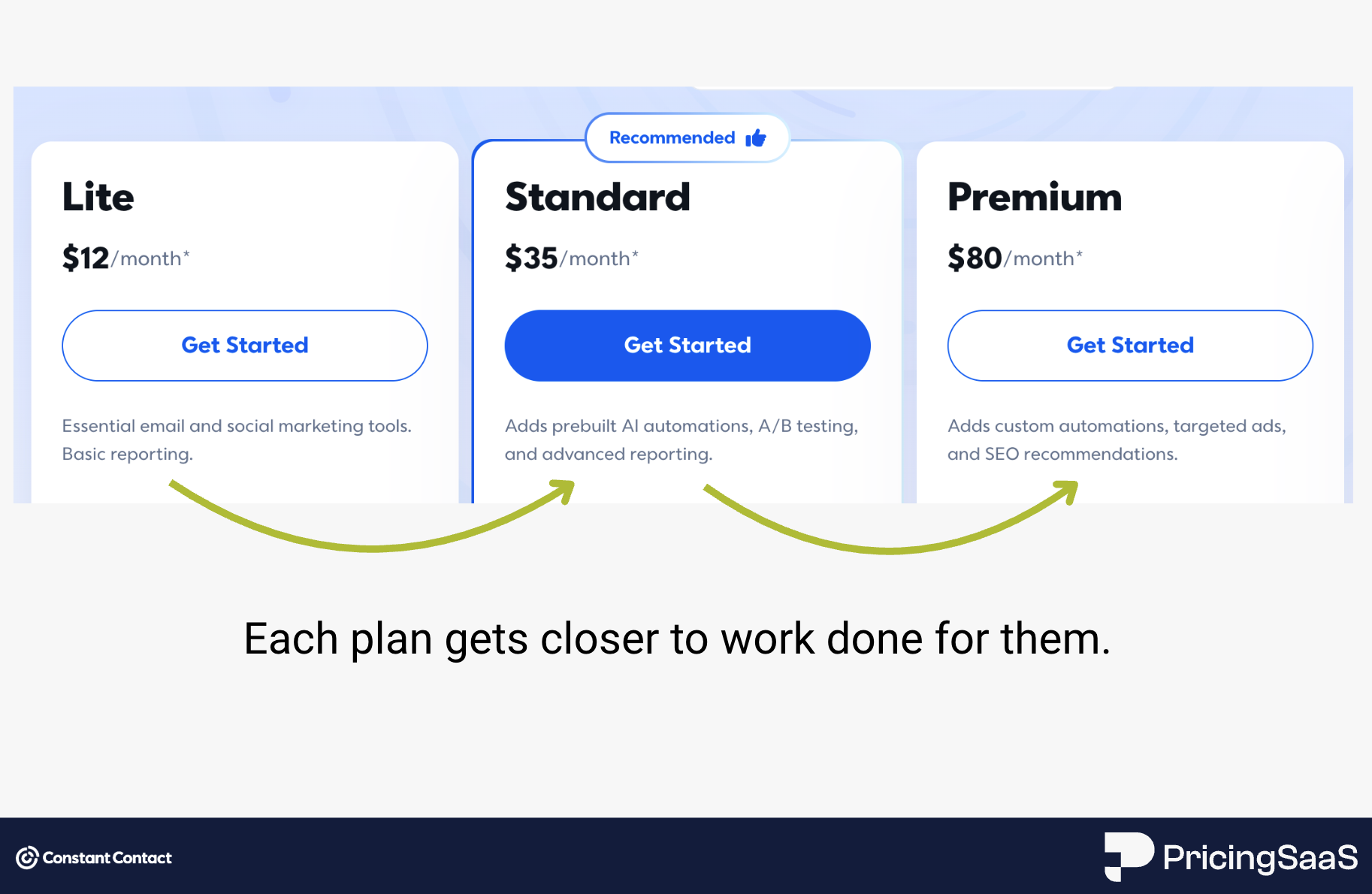
Constant Contact’s shift is a great example of the conservative approach to outcome-based positioning. Previously, their plan copy was pretty boilerplate. Each plan had “best for” language with a short description of features included in each plan.
The new positioning creates an intuitive value ladder:
Lite: Essential Tools (Do it yourself)
Standard: Adds pre-built automations (Do it with us)
Premium: Adds custom automations and recommendations (Done for you)
It would be a stretch to call Constant Contact’s product agentic, but this language shifts the value ladder from pure capabilities to increased out-of-the-box actions that take more off the customer’s plate.
Example 2: Lindy
Added a fake Human Assistant plan (Link →)
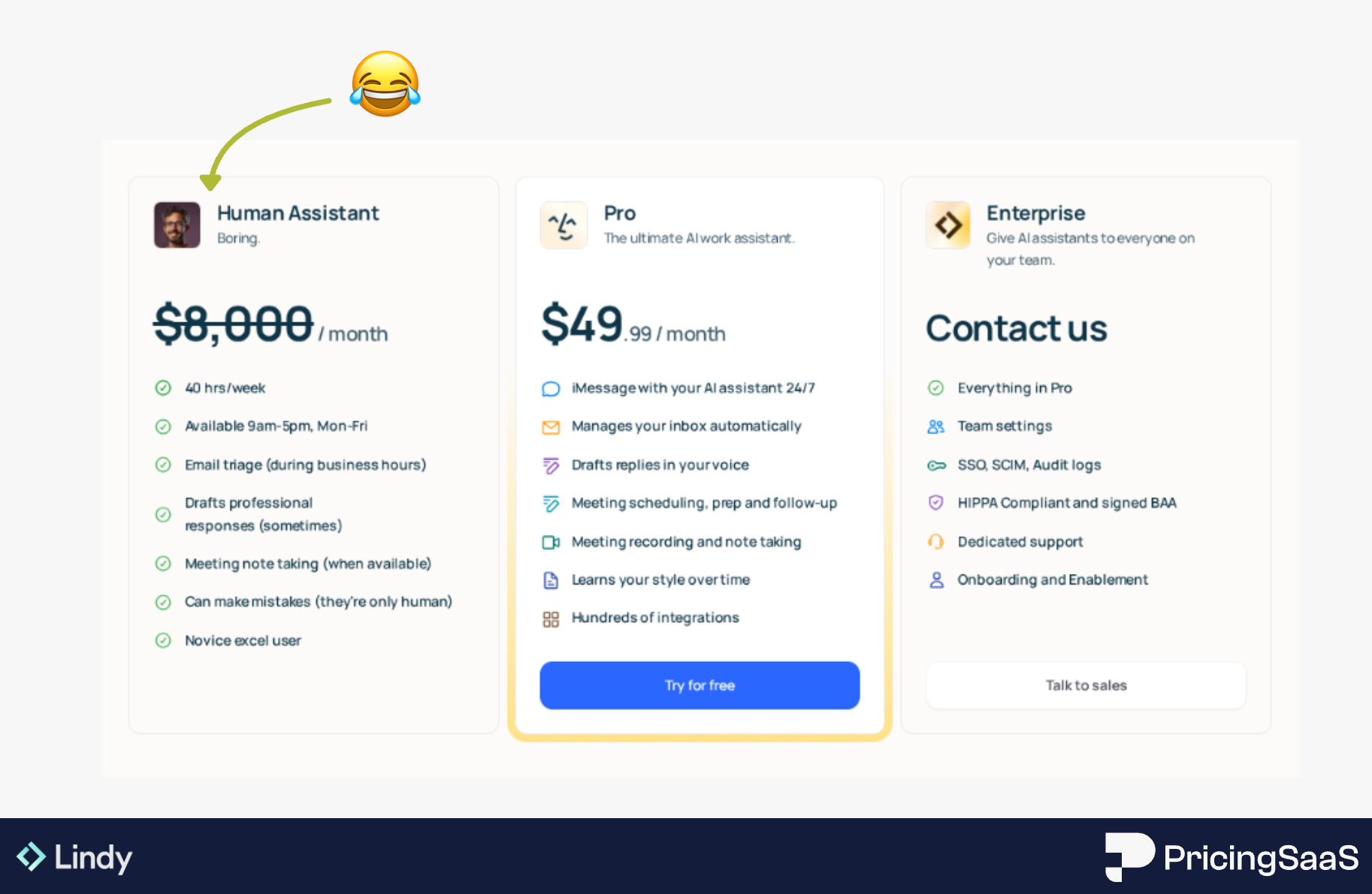
Then there’s Lindy. They added a fake Human Assistant plan to compare to their AI Work Assistant. Previously, they had a similar value ladder to Constant Contact, where plans moved increasingly closer to outcomes.
Now the outcome-based positioning is inherent in the comparison, and the actions the AI Assistant will do for you (email management, scheduling, note-taking, etc.) are listed in the Pro plan.
This is obviously aggressive, but it’s also a smart way for Lindy to communicate the value of their product. I wouldn’t be surprised to see other agentic products start openly comparing the cost of their product to the human worker they’re replacing. Sales reps at these companies are definitely already making the comparison on calls.
Choose Your Speed
The gap between enabling a task and owning a task is the most valuable real estate in SaaS right now.
Whether you take the iterative path like Constant Contact — reframing your existing tiers around service levels, or the radical path like Lindy — anchoring your price against a human salary, the goal is the same:
Stop selling the shovel and start selling the hole.
Even if outcome-based pricing is out of reach, you can start moving your story toward outcomes today. If your positioning is still stuck in the “input” era (number of seats, number of emails sent), you’re already playing from behind.
Thanks for reading! When you’re ready, here’s how we can help:
Community: Answers from real pricing experts. Apply for membership →
Data: Access to news, research, and analysis. Sign up for free →
Advisory: Free pricing advice. Book a 30-minute call →
Interesting approach by Lindy to add the $8k human substitute to their pricing page. Have you seen other companies add substitutes on their pricing page?
If not, it’s at least a way to stand out from the crowd