

Slack is a CRM now
Plus: Updates from Canva, Monte Carlo, Framer, Pinecone, and Mem0

Welcome back to Good Better Best.
Each week, we break down real pricing, packaging, and product moves from SaaS leaders and share the ideas worth stealing.
Today, we’re covering the 3 most interesting pricing changes from the last week, breaking down moves from Slack, Canva, and Monte Carlo.
Let’s get to it.
Before we get there — we’re hosting an Office Hours session next Thursday (4/16) with David Reid of Teneo. David leads Teneo’s Global Private Equity Growth Practice and has helped tons of legacy SaaS companies rework their pricing and packaging for the AI era. If you’re feeling that anxiety right now, this is the one to join — RSVP here.
🔌 PricingSaaS Partners power the next era of SaaS pricing
This Week in Pricing, Packaging, and Product
Last week we observed 100+ changes. The highlights:
Slack adds CRM features view
Canva adds AI allowances, launches AI Pass add-on for power users — view
Jobber hikes list prices — view
Botpress raises Managed plan price 25% as introductory period ends — view
Monte Carlo pivots to AI agent branding — view
Pinecone lifts assistant document caps — view
Mem0 caps Pro plan at 500K add requests — view
Ahrefs doubles Lite plan credit limit — view
Moz launches AI Visibility Dashboards and Prompts Tracked beta — view
Otter adds user limits to Salesforce and HubSpot integrations — view
Framer unlocks analytics history across all plans — view
Mendix removes Customer Success Manager from Standard plan — view
Check out more updates on PricingSaaS →
PricingSaaS Pulse Intelligence
Here’s what was top of mind in Pulse this week:
🔥 Hot Companies
Notion — 29 searches
Mixpanel — 15 searches
Salesforce — 14 searches
Deepgram — 13 searches
Slack — 12 searches
🚨 Hot Topics
Outcome-based pricing for AI
AI add-on monetization bundling strategy
AI pricing credits models
AI agent customer service pricing (per resolution, conversation, token)
AI pricing trends 2026
PricingSaaS Receipts ▶
Breaking down 3 pricing and product updates worth discussing this week.
Slack officially added Slack CRM to the pricing page.
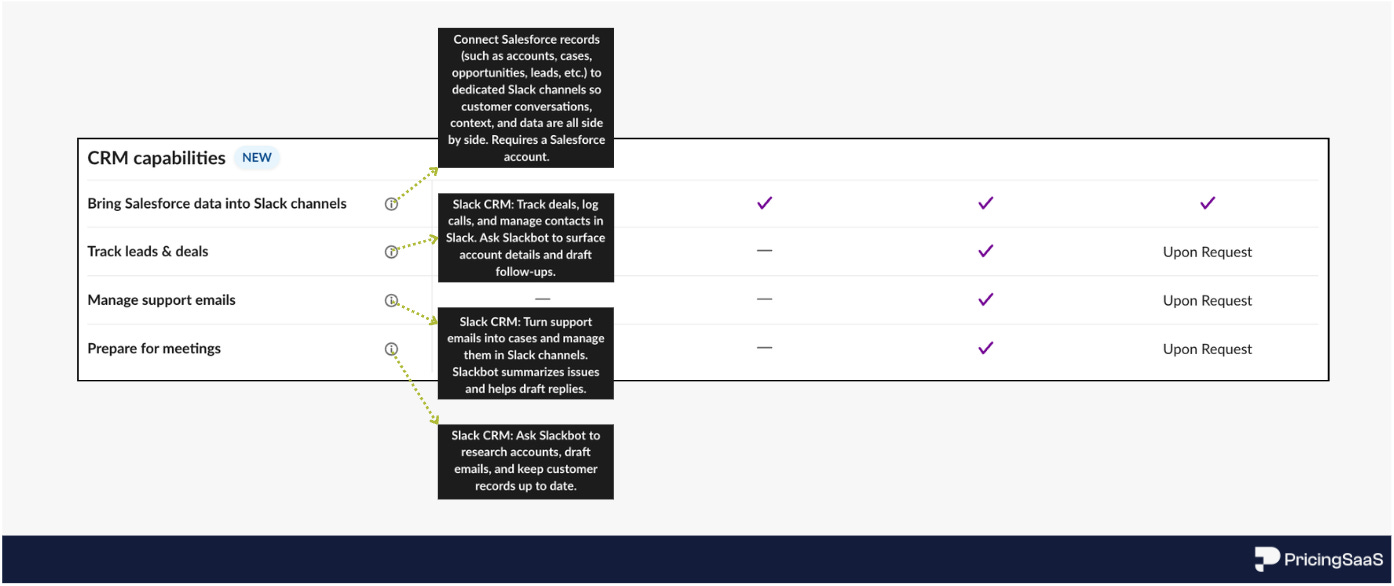
On the pricing page, Slack added a new category called CRM Capabilities, with four features. Notably, only one of the four requires a Salesforce subscription.
The data sync needs an account — but tracking leads and deals, managing support emails, and prepping for meetings all run natively inside Slack CRM, their new small-business CRM that lives entirely in Slack.
The CRM category is already being rewritten by AI-native players like Day AI, Attio, and Clarity — tools betting that in the age of AI, CRM looks different. They’re winning by pulling context from where deals actually happen: call transcripts, email, and Slack. The deal stage lives in the CRM — but the signal around every deal (rep and manager discussions, customer notes and research, follow-ups) overwhelmingly happens elsewhere. That’s the raw material these tools are mining.
Which makes Slack’s move notable. Day AI, Attio, and Clarity are going after startups and SMBs, the segment Salesforce has always struggled to serve without cannibalizing its enterprise brand. Slack CRM gives Salesforce a clean SMB entry point — no legacy baggage, that sits on top one of the richest context layers imaginable.
On the pricing front, Slack CRM is gated to Business Plus and Enterprise Plus. Free or Pro customers can pipe Salesforce data into Slack with an active Salesforce license, but need to upgrade to access Slack CRM. It’s a clean monetization fork: you’re either already paying Salesforce, or CRM becomes the hook to move you up a tier.
Canva introduced AI limits and a new AI add-on.
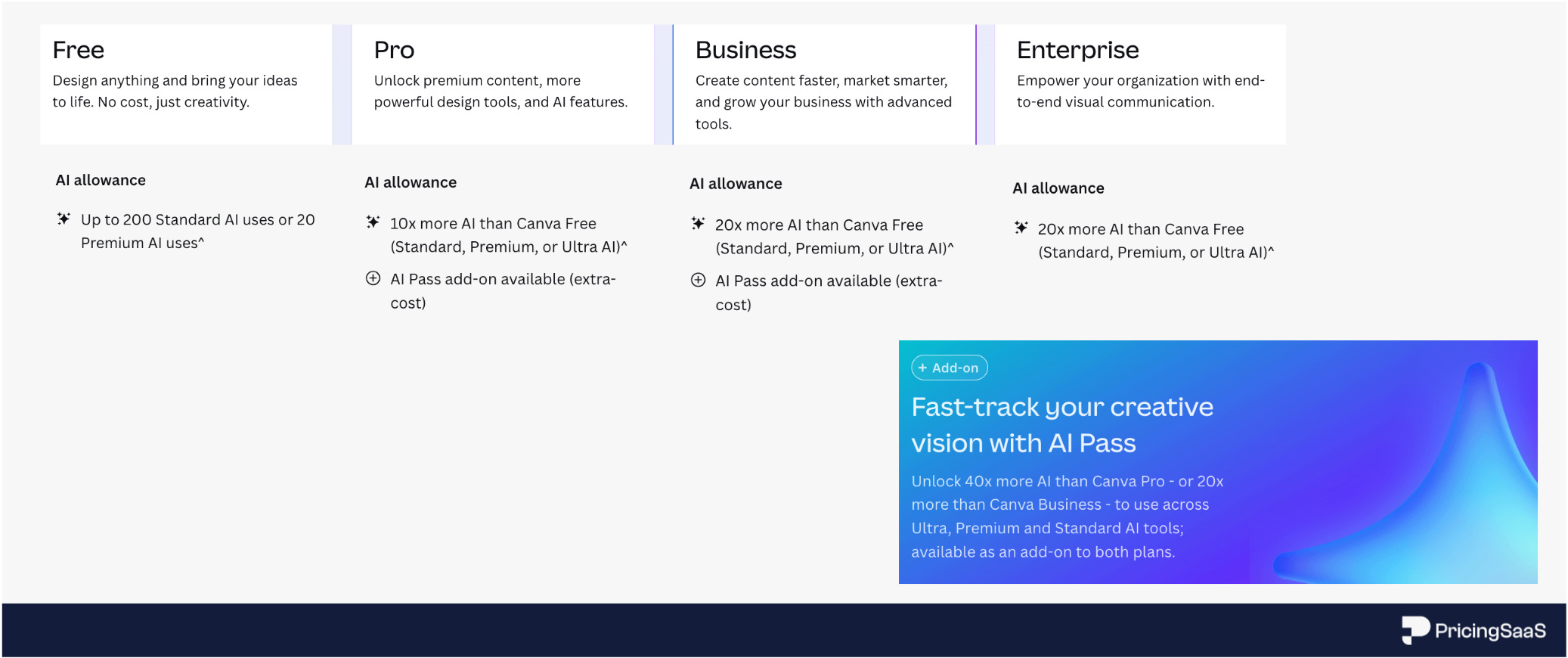
Canva made two moves worth paying attention to, both about one thing: figuring out how to price AI inside a plan structure that was never designed for it.
1️⃣ They added explicit AI allowances for each plan. Before, Canva used vague language around AI usage limits. Now every plan has a clearly defined limit, which is framed as an “allowance.” It’s a purposeful word choice. An allowance feels like a gift. A limit feels like a punishment.
2️⃣ They introduced the AI Pass add-on. They also introduced a new add-on called AI Pass at $100/month, which unlocks 40x more AI than Canva Pro (or 20x more than Canva Business) across Ultra, Premium, and Standard AI tools. Notably, AI Pass is gated to paid plans, creating two ways for Canva to grow accounts with AI usage:
The allowances drive paid conversion and tier-to-tier upgrades.
AI Pass offers additional expansion for power users.
The biggest question here is why not just use credits like everyone else? If the whole mechanic boils down to “how much AI did you use this month” credits are the cleanest expression of that.
Canva seems to be betting the simplicity of fixed allowances and a flat-rate add-on is preferable to credits for their SMB base, which would make sense if their AI features were simple. However, they’re already introducing complexity by categorizing their AI tools as Standard, Premium, or Ultra. Honestly, a simple credit model that charges more credits for more complex tasks would likely be easier to understand.
Monte Carlo rebranded the entire pricing page around agents.
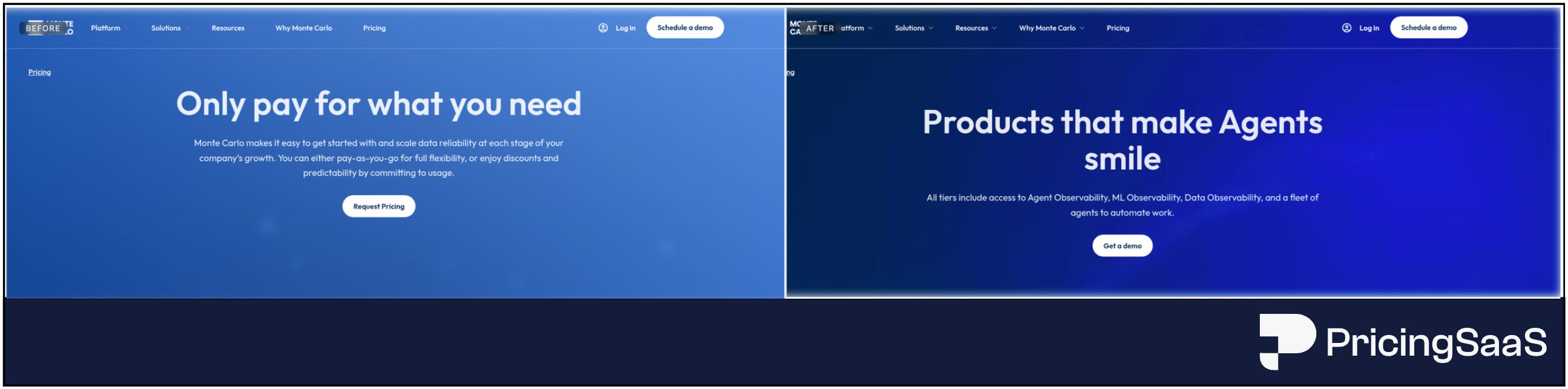
In the top positioning move of the week, Monte Carlo rewrote its pricing page around AI agents. The headline changed from the very 2023-coded “Only pay for what you need” to “Products that make Agents smile.”
Why agents, and why now?
Monte Carlo has been openly building toward this. Last September, they launched Agent Observability to monitor the context, performance, behavior, and outputs of production AI agents end-to-end. The market data they cite explains the urgency:
Nearly 80% of enterprises have already deployed AI agents
More than 40% don’t trust their AI/ML model outputs
45% call data quality their top AI obstacle
53% already expect to significantly rebuild the agent systems they just shipped
Read between those numbers and the repositioning makes sense. Monte Carlo built its brand catching broken pipelines before they wrecked dashboards — targeting data engineers buying for BI teams.
Once enterprises pipe production data into agents that take autonomous actions, “the dashboard looks weird” turns into “the agent made the wrong decision a thousand times before anyone noticed.”
That’s a different risk category and a different buyer: the platform team standing up agent infrastructure, who needs a guarantee that the data and the agents on top of it are trustworthy in real time. This repositioning is their bid to reframe data observability as agent reliability infrastructure, in all likelihood a much bigger and more urgent budget line than BI hygiene.
Thanks for reading! If you’re working on monetization and want to learn more about how we help, book time here.
Until next time,
Rob
As applications become conversational, it makes sense that CRM functionality will migrate to applications where conversations occur. How will this impact pricing? Will prices be based on the number and quality of the conversations? It is also worth discussing the whole headless app phenomena in this context.