

The Backstory behind Clay's new Pricing Model
Plus: Updates from Asana, Dashlane, Optimizely, Anthropic, and Amplitude.

Welcome back to Good Better Best.
Each week, we break down real pricing, packaging, and product moves from SaaS leaders and share the ideas worth stealing.
This week, we launched our first Pulse Skill. It’s called Market Map and allows you to do competitive research that used to take hours (or days) in minutes. If you’re new to MCPs and Skills, here’s how we’re thinking about it:
▶ PricingSaaS MCP is the intelligence layer — it connects your AI tool directly to our data in PricingSaaS Pulse, where we’re tracking thousands of SaaS companies.
▶ Pulse Skills are the action layer — they sit on top of the data and provide instructions for specific, executable workflows to make it immediately actionable.
Learn more here, and reach out if you run into any questions.
Today, we’re breaking down the backstory behind Clay’s new pricing model that took over the pricing world last week. Huge thanks to Zona, Clay’s monetization lead, for sharing how it all went down! Let’s get to it.
🔌 PricingSaaS Partners power the next era of SaaS pricing
This Week in Pricing, Packaging, and Product
Last week we observed 150+ changes. The highlights:
Asana revealed prices for its Timesheets add-on at $5.99/user. Link →
Dashlane unbundled Credential Protection at $4. Link →
Optimizely consolidated experimentation products. Link →
Anthropic API simplified pricing and removed volume-based tiers. Link →
Conjointly raised prices for the Professional plan. Link →
Airwallex shifted the Grow plan to $12/user pricing from flat $99/month. Link →
BigCommerce payment processing fees. Link →
Amplitude added AI Agents & MCP features across all plans. Link →
Triple Whale removed monthly credit limits. Link →
Together shuffled its model lineup. Link →
Check out more updates on PricingSaaS →
PricingSaaS Pulse Intelligence
Here’s what was top of mind in Pulse this week:
🔥 Hot Companies
Clay — 20 searches
Notion — 18 searches
Wrike — 14 searches
Smartsheet — 11 searches
Anthropic — 10 searches
🚨 Hot Topics
Agentic AI monetization — credits vs hybrid license vs outcome-based pricing
AI credits pricing models — structuring credit-based systems for AI features
Developer tools unit economics — LLM costs, per-seat vs usage margins
Annual discount benchmarks — contract terms, ACV sensitivity, SMB churn
Free-to-paid transition strategy — beta pricing, change management playbooks
The Backstory behind Clay’s new Pricing Model
You’ve probably used Clay’s pricing page as a reference in the past couple years. Their credit-based model became the template of the AI era. Kyle Poyar called it out. Pricing consultants put it in decks. If you wanted to show a client “this is how credits should work,” you pulled up Clay.
So when Clay announced last week that they’re restructuring their entire pricing model — introducing a completely new “actions” metric alongside data credits and consolidating from five tiers to four — it raised a big question: why change something that’s working?
I sat down with Zona Zhang, who leads monetization at Clay, to get the full story.
I. Why it went down
Clay originated as a data enrichment tool, and the credit model fit perfectly. You buy credits, you spend them on data. Clean and simple. But over time, Clay’s customers started using the product for orchestration, which didn’t fit into their credit model.
“We saw a lot of users bringing their API keys and connecting all of their systems, which is great to see,” Zona said. “However, we only monetized on data. We knew we were going to continue to invest in higher scalability and better capabilities for people doing orchestration workflows, and the cost of the product would reflect that. But if we only charged for data, we would start to get feedback from the market like, ‘Clay is selling data at a high premium — it’s 2x what I’d get if I go straight to a provider.’ We don’t want to put ourselves in the position where we’re not monetizing the platform for people who come for the platform, but then overcharging people who are just here for the data.”
The more valuable Clay became as a platform, the less its pricing captured that value. And the data-only customers were subsidizing a platform premium they didn’t ask for. In other words, the model that powered Clay’s growth no longer aligned with where they were going.
II. How it went down
Phase One: The Memos
This wasn’t a snap decision. Zona said the first conversations that led to this change started over a year ago. What followed was three distinct phases of iteration.
Phase one was the longest and hardest — a small working group banded together to get the hypothesis right. Zona and Karan (Clay’s CFO) wrote the internal pricing memo four or five times. They talked to 30+ agencies. They interviewed self-serve customers and enterprise buyers from different segments, making sure each cohort felt pricing was fair.
“I doubted myself maybe 20 times,” Zona said. “I kept thinking, should we just ship something and see how people react? But in the end, I appreciated us being extremely critical with the process. Because later on, as we implemented all these details and tried to bring it to market, everybody started to question every small decision. And we had the documentation to explain why we made that choice.”
That documentation became their internal objection-handling playbook. When every stakeholder questioned a small decision, Zona could point back to past memos and speak to the reasoning behind each decision.
Phase Two: Implementation
The model Clay landed on draws inspiration from Snowflake’s pricing architecture — a platform component and a commodity component (e.g., compute vs storage). In Kyle Poyar’s post breaking down Clay’s update, he called this new model Platform + Tokens, where the platform can garner ~80% margins, and tokens garner ~20% margins. In Clay’s case, it’s actions (platform) and data credits (commodity).
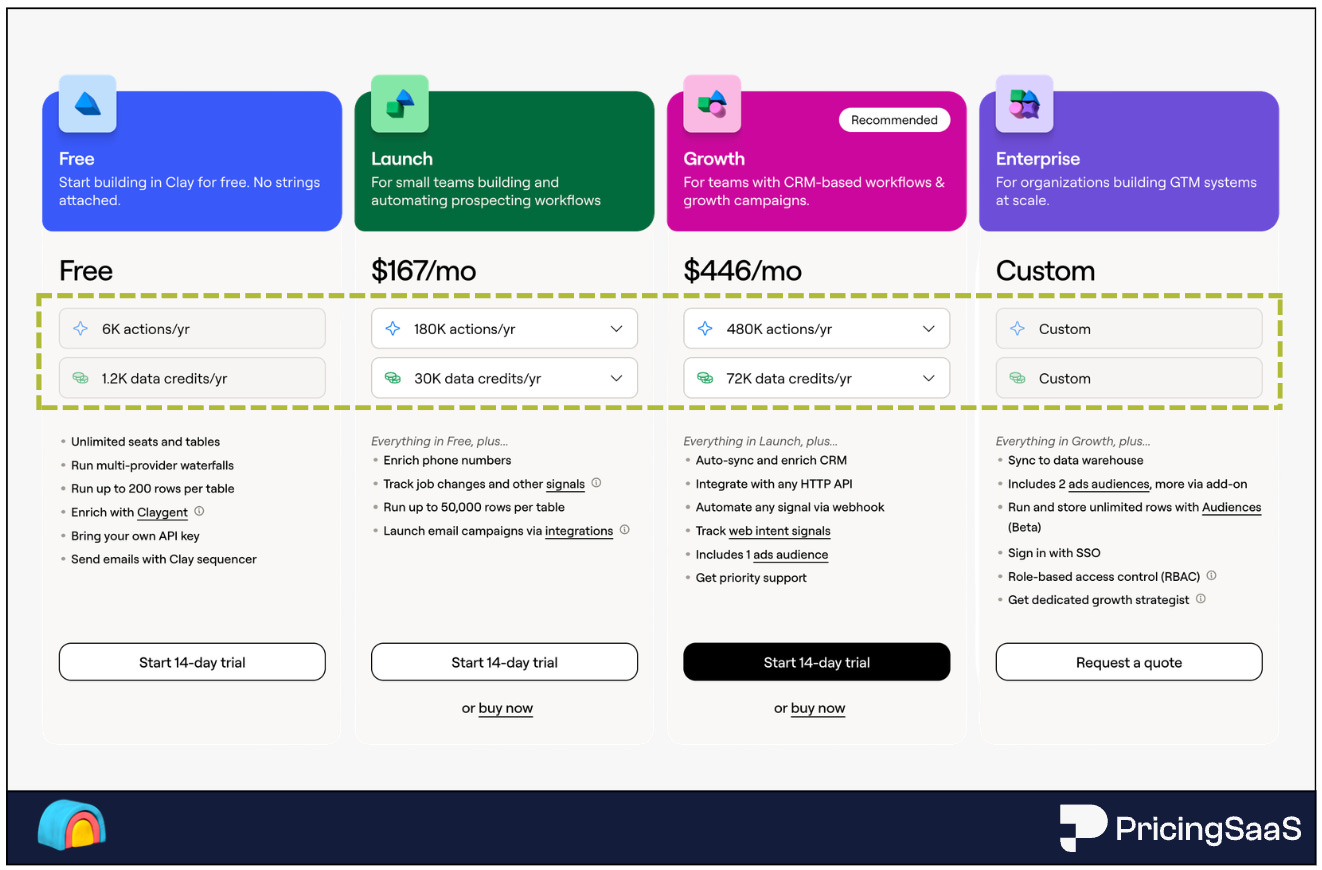
Why actions and not a simple platform fee? Zona walked me through the logic:
“Everybody likes a platform fee — it’s non-controversial. But the issue is it doesn’t scale. We sell to both PLG and enterprise customers. Platform fees make perfect sense to self-serve customers. When customers expanding from self serve to enterprise, they have to suddenly predict their usage, but don’t have that habit from when they were on the self-serve plan. Now it feels like Clay is taking something away from them and it becomes unpredictable.”
Actions solve this by introducing the concept early, while making it invisible for most users. Clay set the initial action limits so that 90% of users won’t need to think about it — effectively functioning as a platform fee for them. But for the 10% who are power users? They’re already thinking in terms of actions, so the upgrade to the next tier feels natural rather than jarring.
The insight that locked the metric in was about how differently each record gets treated inside Clay:
“If you don’t care about the data quality, you’re doing a super large outbound campaign — you’re probably just spending half a credit on every email and another half a credit generating a very generic AI message. That’s cheap. And you don’t want to charge that one record the same amount as your ABM target list that you’re doing months of account research on, where you’re actually contacting only five people a month per rep. Our customers differentiate the value of every lead, and Clay is the right tool that can give you differentiated value per lead. That’s why we decided to use actions instead of a record or a row or an export.”
Notably, Clay expects to see a 10% drop in revenue in the short-term due to reduced data costs. Over time, however, Zona and the team expect customers to upgrade as their actions yield better and better results, creating another expansion lever beyond data credits.
Phase Three: The Launch
We see a lot of pricing changes at PricingSaaS. Often, they slip by quietly, under the radar. Clay did the exact opposite.
“The first version was, let’s just publish a memo,” Zona said. “Let’s say the honest things and tell them how much we’ve thought through this and show all the math. And then our marketing team really pushed back. They were like, no one wants to see all the math. You should do a video that talks to people like humans.”
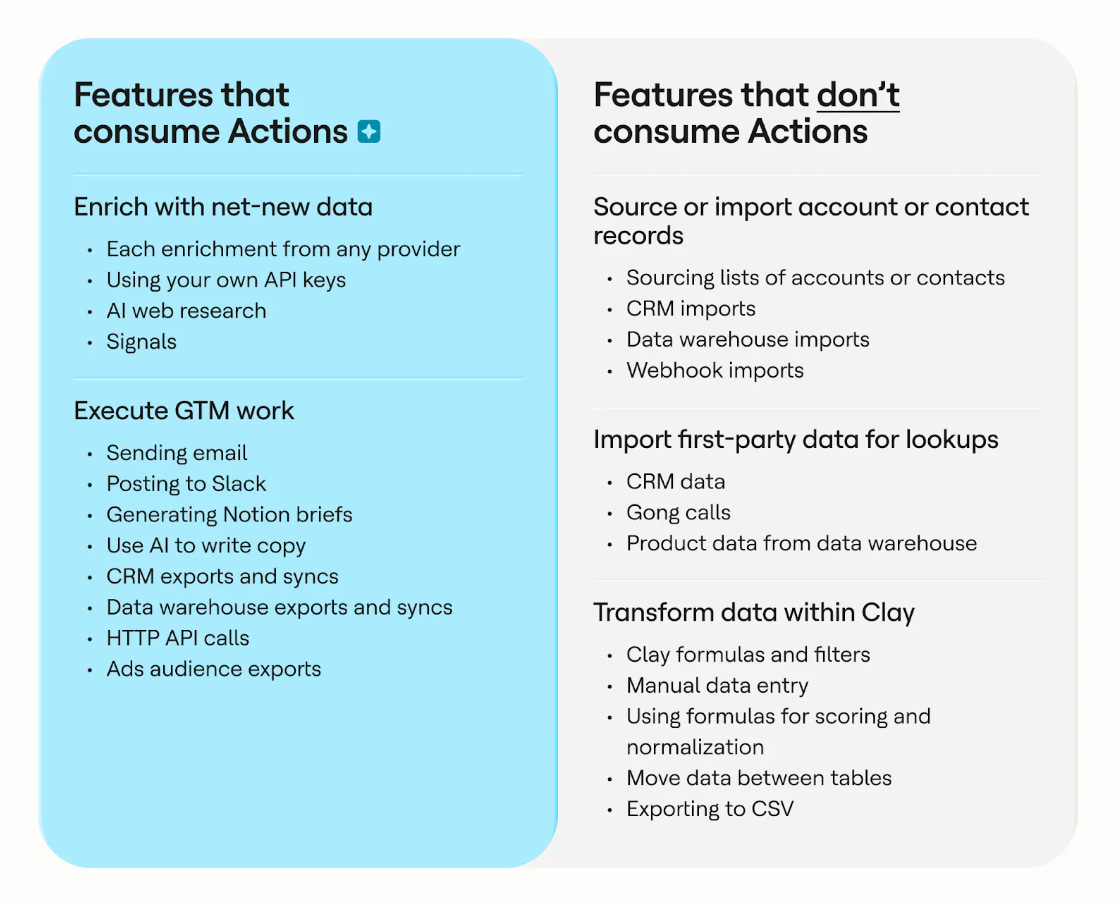
So Varun and Karan recorded a long-form video walking through the reasoning, and posted it to LinkedIn. If you watch it, you can see Varun looks a little nervous, which Zona confirmed was genuine. Karan published the public memo with the math as a companion piece. Every executive posted on LinkedIn explaining the “why” in their own words. The FAQ section on the pricing page (which Clay has always used strategically) got its own revamp, with an especially helpful guide breaking down which features do and don’t consume actions.
And then there’s the grandfathering — where Clay went against conventional wisdom, allowing customers to stay on legacy plans, and still benefit from new functionality.
“We did something that every pricing expert told us not to do,” Zona said. “We grandfathered existing customers without a cutoff time There might be one day where we have to sunset this, but there’s no formal timeline. And the way we’re thinking going forward is — anything that’s a quality-of-life improvement, we should give it to legacy plans too. We want to show the community that we’re still servicing you, instead of saying we’re only going to build for enterprises now. “
The only exception is genuinely new use cases, like Clay’s new ads product, which is exclusive to modern plans because it serves a completely different persona (marketers, not rev ops). Zona believes there will eventually be a natural tipping point where it’s economically better for legacy customers to move to the new pricing. But they’re not forcing it. They’re letting the product make the case.
III. How it’s going
The early reception has been overwhelmingly positive — particularly on the transparency and communication of the launch. But the most interesting signal is what customers are asking for next.
“People are asking very good and thoughtful questions. A lot of people asked for detailed mapping of their historical usage, and they want to know how that informed new pricing. Currently, if we think you should move to the new plan, we’ll give you a recommendation based on your historical usage. But there’s an argument to give people more information and see what they do with it.”
The one area that’s still being iterated on: AI variable pricing. Because Clay charges for AI the way OpenAI or Anthropic does — based on actual compute consumed — users are pushing back.
“People are so used to seeing a fixed-cost menu before you run everything,” Zona explained. “They have expectations. If you tell me you’re going to withhold five credits, that means five credits. You should not charge me six, you should not charge me four.”
The UX around setting expectations for variable pricing is actively being iterated on.
IV. The takeaway
Clay’s move is a signal for every SaaS company running a credit-based model: your pricing metric needs to evolve with your product. If your product started as one thing and became something bigger, your pricing probably hasn’t caught up.
But the deeper lesson is about process. Clay’s patience and internal documentation turned uncertainty into confidence. The memos. The objection handling. The transparency at launch. Every step compounded into a pricing change that landed well because it was battle-tested long before it went live.
Thanks for reading! When you’re ready, here’s how we can help:
Community: Answers from real pricing experts. Apply for membership →
Data: Access to news, research, and analysis. Sign up for free →
Advisory: Free pricing advice. Book a 30-minute call →
Thank you for sharing this. I have seen some criticism of Clay for having two pricing vectors but in this case I think it is the right design and that actions vs. data is a good distinction, and not just for Clay.I think we will see more and more pricing that applies credits to actions. The key will be to connect actions to value!